
 (-1 rating, 5 votes)
 Loading...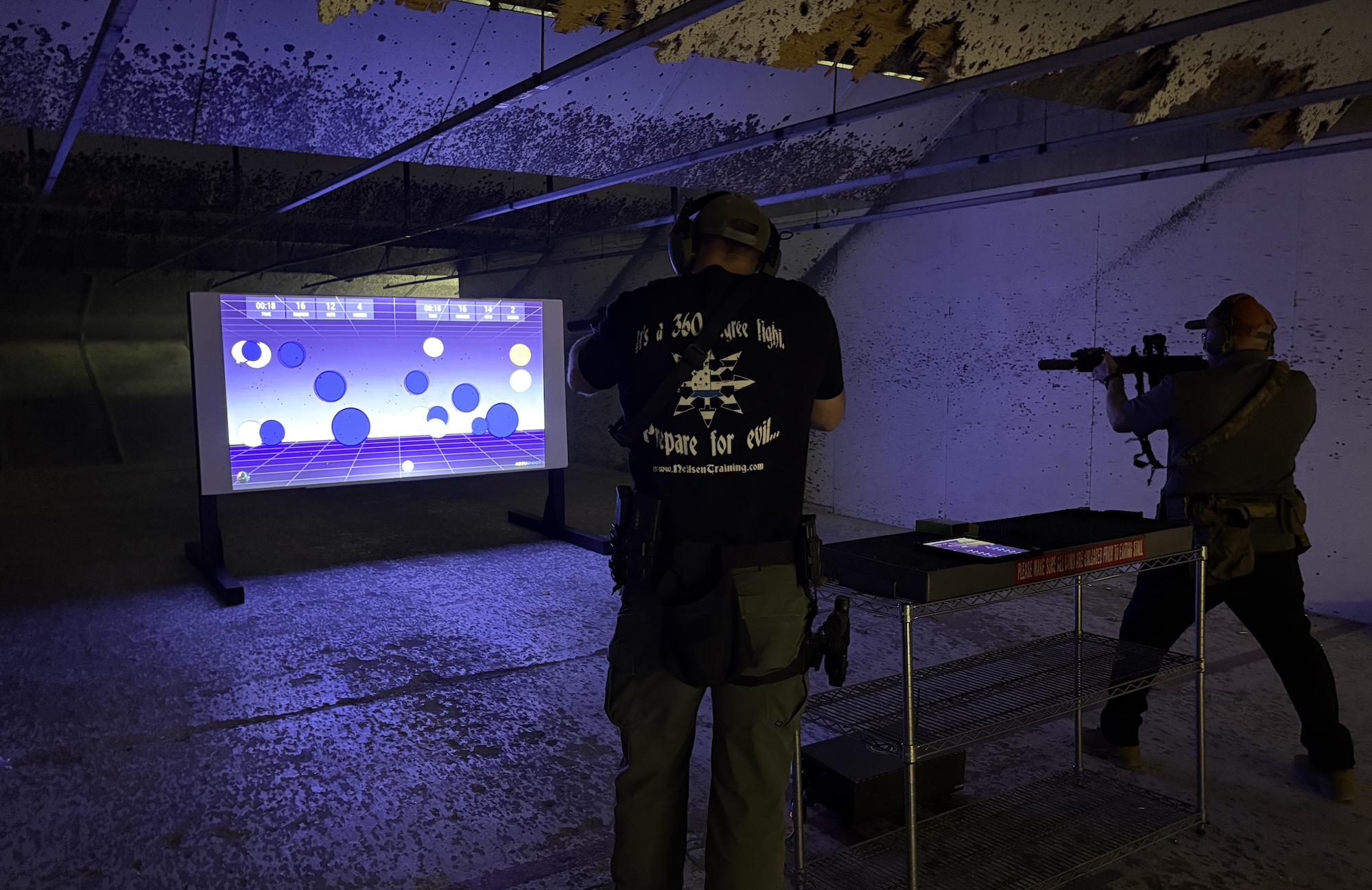
featuresspheres_8607
Very few police officers will ever receive all the live-fire range time they need. Even fewer will have the time they need to engage with another person in training to develop and solidify their skills in areas such as human interaction, judgment, and decision-making. Range work and scenario training in both areas require specialized facilities (each very different) and support staff, including instructors, role players, and safety personnel.
How can “we” – those in the profession tasked with providing these types of training – get our people enough of those repetitions? A way is with simulators. They can be run all hours of the workday.
Evolved
One of the first research papers I had to write in grad school covered the acquisition of use of force simulators by law enforcement agencies. The variety of simulators available has only increased since then – 2014. Additionally, there have been huge leaps in the technological capabilities of those systems over that time.
There are a few limitations, one of which is the availability of someone to operate it. Another includes the feel and function of the “firearms” often used in them. The physical sensations that go with the firearm do not occur in those simulators. Additionally, officers are not using their weapons.

Screenshot of the data, including the hits, being replayed after the drill.
Accu-Shoot
Last month, a law enforcement acquaintance reached out and invited me to a demonstration of a new simulator system. It is called the Accu-Shoot LFX – the LFX part referring to the live fire capability in this system. In addition to me, representatives from a federal law enforcement agency and commercial ranges were also present.
Accu-Shoot is specifically designed for use on an indoor shooting range. To achieve this, they have designed a single-plane screen that lasts for 3,000 to 4,000 rounds. I can be split into smaller sections, each of which can be moved as well. A complete replacement screen currently goes for $150.
How?
The system includes an FLIR-branded and manufactured infrared (IR) camera that reads the heat signature of the fired round striking the screen. The internal software ties the location and time of the shot to the exact image on the screen at that instant.
In addition to traditional ammunition, such as jacketed lead-core, it will also work with frangible ammunition, like that used by some organizations.
Most of the programs I saw utilized moving targets in various designs, such as USPSA and spherical targets. Those movers lengthened the screen’s life by constantly adjusting impact points.

The hardware components of the system include the hard drive, the projector, and the IR camera that records the hits.
Soft Ware
As with nearly everything else these days, there is an app for the system. Along with allowing the instructor to set the program, it enables the sharing of all recorded metrics, including shot timer data, split times, and more.
I prefer drills that include No Shoot and/or No Cover targets mixed in with the shoot targets. The Accu Shoot supports that and other forms of target discrimination. Depending on the program, it can have those No Shoots crossing in front of or behind the Shoot targets.

An initial Accu-Shoot drill with multiple, moving targets.
Just Inside?
The system will work outdoors – IF you can keep the sun completely off the screen. The Accu Shoot crew gave one example of this. They took it to Thunder Ranch, out in the high desert of eastern Oregon. Sheltering it in a tent, they had it at just about 450 yards from the firing line.

How the holes appear on the screen. An IR camera in the projector reads the heat signature on the holes and records it.
One advantage I saw to the system was that it allowed, but did not require, the use of scenarios developed by the manufacturer. Accu-Shoot specifically allows uploading body-worn camera footage or similar types of video. Users can then work through the same situations that others have encountered. And organizations can also film and upload scenarios using locations specific to them.
All the scoring is done via A/I. This allows you to set it for T-Box only hits, or for suspects with armor, as well as arms and legs.

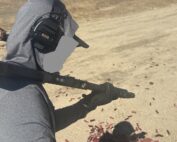
The backside of the screen and the holes created during the demonstration.
Cost & Access
Currently, Accu Shoot is focused on getting its live fire simulator system into use in various ways. 1st is with law enforcement agencies. Second, they want to see commercial ranges adopt it and allow the public to use it that way. Ultimately, they hope that existing training programs will adopt it and utilize the various benefits it offers.
For the complete system (integral control box with projector, plus a complete screen), the price is $12,500.

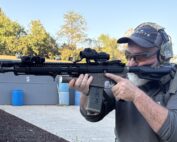
A federal criminal investigator is shooting a scenario employing body-worn camera footage uploaded into the system.
Accu Shoot has developed individual accounts for clients of commercial ranges and training programs who have purchased the LFX. They have also integrated with Practi-Score, which allows your data to be uploaded immediately to that program.
Thoughts
During the demo, I observed several attendees using it. Based on those observations and my brief experience firing a few magazines through an iron-sighted Glock in multiple scenarios, the system appears to accurately process shots and hits or misses.
I have used most, but not all, of the Don’t Shoot/Shoot firearms and decision-making simulators out there. Additionally, I did in-depth research on earlier versions. I am sold on them and the variety of benefits they provide. While the Accu Shoot does not give me 180 degrees, let alone 270+, it does allow for the use of actual firearms and ammunition, which the others do not. Due to the nature of the screens and the system’s cost, it could be used in multiple rooms within a life fire shoot house. And that’s pretty cool.