
 (+5 rating, 5 votes)
 Loading...
Feature_8811
HDCC's current offerings for the 632 UC Ti revolver.
We are about a year and a half into the S&W UC revolvers that Lipsey’s brought to market after significant collaboration with competent end users. My original article on the gun can be found HERE. So, how is the line progressing?
Choices
Looking at the 632 Ultra Carry, I initially planned to go with one of the .38 Special models. While holster fit was not a question, I did not see the need to add yet another caliber to the shelves in the garage.
That changed when I had a chance to shoot them at Lipseys’ first media event. Especially after I saw the Double Tap ammo snake shot load go into Clear Gel. Its performance, as well as the extra round (6 instead of 5), changed my mind.
It took a while for one of the UCs to make its way to me, via my local gun store at the base of the Wasatch Front. Specifically, the 632-UC Ti (as in Titanium)

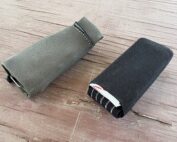
A properly staged Tuff Products Quick Strip, two rounds and a space, repeated.
Ammunition Order
Once the UC arrived, I ordered a smorgasbord of .32 caliber ammunition from High Desert Cartridge Company. High Desert (or HDCC) is a surprisingly well-kept secret in the ammunition business. Run by Steve Shields out of Goldendale, Washington, they are producing a variety of handgun and rifle ammunition based on direct input and feedback from well-known instructors and serious end users.
One of those people I talk with regularly is Bryan Eastridge, of American Fighting Revolver. Frequently referred to as “Y” based on the spelling of his name, he consulted on the development of the UC line.

The four HDCC loads I used with the 632 UC – S&W and H&R 98gr wadcutters, a H&R 100gr Round Nose Flat Point, & 100gr JHP.
And while I covered much of the AFR input in the first article, I was curious whether he had any additional thoughts after 18 months. He shared the following.
With the titanium model, their goal was to get as close as possible to 13 ounces unloaded.
It has become a very popular revolver with the extra round and reduced felt recoil.
He sees a common theme: devoted shooters loading their gun with .32 H&R Wadcutters from HDCC for easy extraction and using the 100-grain XTP bullet load as the reload.
Weight
The 632 UC Ti weighs 15.0 ounces loaded with six rounds of 98-grain wadcutters, while my Model 442, in .38 Special, weighs 17.2 ounces with five wadcutter rounds.

Two wadcutter groups, standing at 7.5 yards. Very soft focus on that XS dot front.
Ammunition Performance
What about High Desert Cartridge Company? I first became aware of them a few years back, when I met Steve at the Pat Rogers Memorial Round-Up (which is happening again the weekend after this article is published). I picked up some of his .38 Special offerings and was quite pleased. For about the last 16 months, I have been buying a fair amount of his 124-grain 9mm offerings and his 55-grain .223 ball loads, both for use in classes and demonstrations.
A Marine veteran uncle taught Steve how to shoot when he was growing up. He started with a Hi-Standard .22 pistol, then moved on to lever-action Marlins and an M-1 Garand. He bought his first handgun in 1984, a Dan Wesson 15-2 .357 Magnum.
He began handloading in 1984. During his L/E career, he went from ordering training ammunition from one regional company to working there. Later, he entered a partnership and opened High Desert Cartridge Company. Their initial offerings were in 9mm, .45ACP, and .223 – running one Mark 7 reloading machine for each caliber.
HDCC’s semi-automatic range loads are made with once-fired brass. Those loaded with jacketed hollow points for semi-autos and all revolver loads use new, unfired brass.

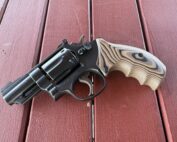
A close-up of the 632 UC Ti – XS dot front, u-notch rear, titanium cyclinger, and a shrouded ejector rod.
Post-production, every single round passes through a SAAMI-specification chamber gauge that measures all aspects of the round. This process ensures they are within the SAAMI specification dimension-wise. Steve was adamant that every round was checked, not a batch nor randomly pulled rounds; every one of them is checked.
HDCC has deviated from the industry norm, with loads he believed were over-pressured or too high-velocity, resulting in excessive blast or recoil. In those cases, he worked with a variety of instructors and shooters to develop loads that performed without the negatives.
.32 Caliber
Specific to the .32 caliber line, he was asked to develop products calibrated to Smith’s .32 UC line. In doing so, these loads also perform well in the Ruger .32 LCR. Steve said that, as with the other caliber offerings, HDCC is producing a defensive load as well as a range load, both of which print to the same point of aim.

7.5 yard standing group with the JHP load and a -sigh- called flyer.
Chronographed
The 632 UC Ti has a 1.875” barrel, to be more specific what we normally identify a 2” length. From it, I got these feet per second (FPS) numbers:
.32 H&R 98 gr WC – 831.9, 807.2, 839.4, 824.5, 817.8, and 783.0;
.32 S&W Long WC – 798.3, 808.1, 750.4, 788.0, 811.9, and 779.3;
.32 H&R 100gr JHP – 866.0, 877.0, 859.6, 863.5, 865.5, and 886.7;
.32 H&R 100gr RNFP – 922.0, 909.3, 860.4, 904.9, 939.6, and 906.5;

The 100gr RNFP group from 7.5 yards, and you can blame me for that one too.
Hits
My final range session with the .32UC Ti involved a series of B-8 bulls eye shot off-hand at seven and a half yards.
Shooting with a very soft focus on the XS Sights’ small dot and u-notch rear, I kept most everything in the black. That was a “me” issue, not a gun-and-ammunition issue. I had a flyer with each of the JHP and RNFP loads, both of which I called.

There is “only” a 2.2oz weight difference between the 632 UC Ti (15.0) and the .38 Spl 442 (17.2) when loaded to capacity with wad cutters. But that extra round is a thing.
Final Thoughts
For at least 20 years, I have been loading my J-frames with wadcutters for carry. The HDCC wadcutters did not disappoint. I would absolutely carry this gun with the HDCC wadcutters. They shot to my point of aim, and the perceived recoil was very manageable.
My thoughts on the UC line have only solidified. There are times and places where a lightweight, hammerless revolver is THE choice. Two of those are as a backup gun on duty and for pocket carry at home. I would carry this in both roles without hesitation.
RESOURCES