
 (+5 rating, 9 votes)
 Loading...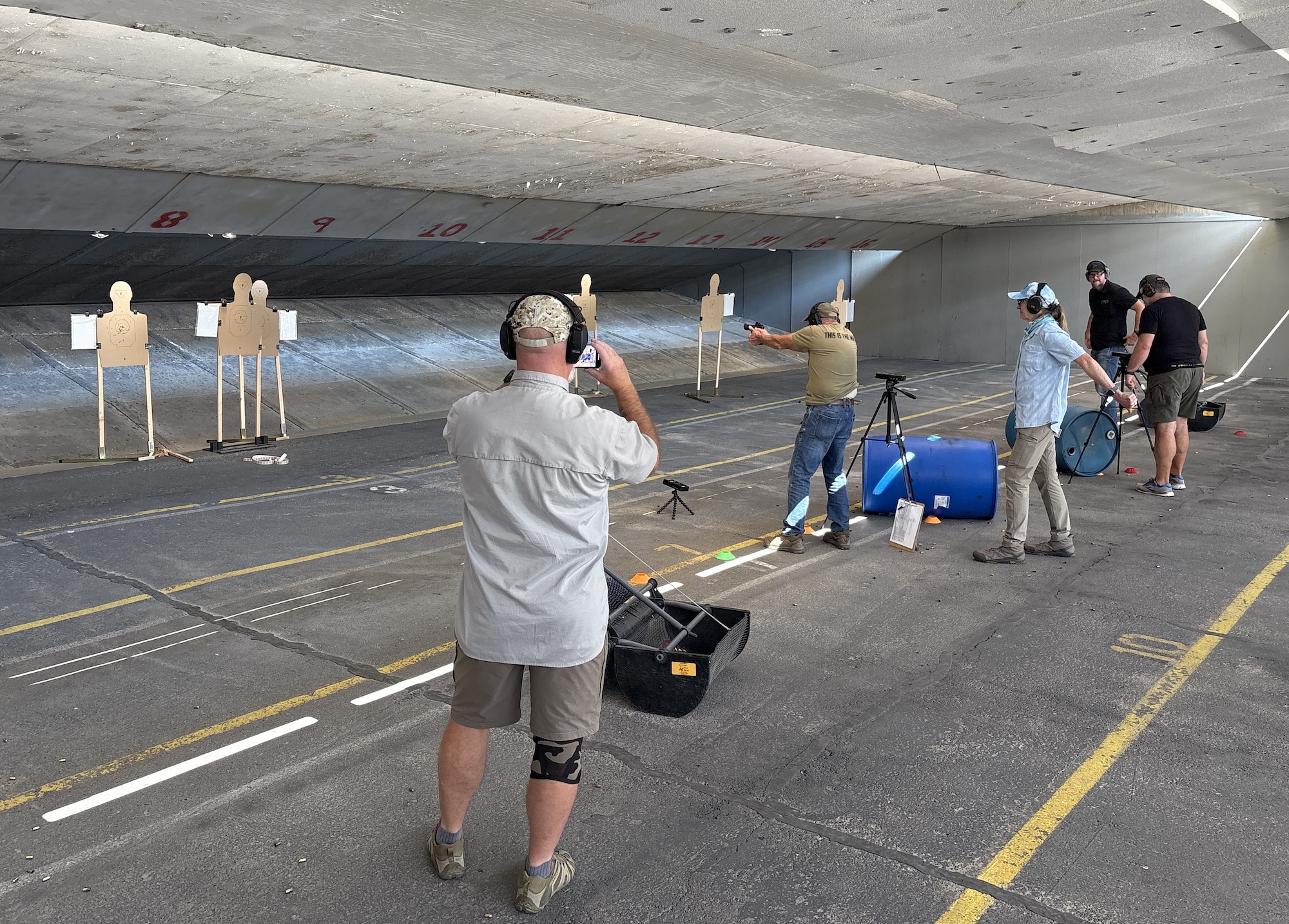
featurebreadth_8409
Targets arrays, NURO projectors, students, and both assistant instructors.
I spent this past weekend taking Heiho Consulting Group’s Applied Defensive Handgun Skills class. To say it was not what many perceive a shooting class to be is an understatement. One example, my round count was about 350. The best description of the material was that this class was hitting the weight room to build your visual perception skills.
Often, judgmental shooting drills involve calling out colors or numbers. That leads to responding, rather than thinking or responding to evolving conditions.

Marcin is talking me through the data from one of my runs.
Heiho Consulting’s principal, John Holschen, has taken the concept and put it into action in a way that surpasses what previously existed. He achieved this by developing a series of drills for the NURO, a laser-projecting smart shot timer, designed by Dustin Solomon.
Who & What?
Dustin Solomon is a former U.S. Navy officer who wrote Building Shooters, Hitting in Combat, and several other books. All of them on how to develop and train shooters based on science, rather than traditional methods.

Just some of the data collected during various evolutions.
Solomon developed the NURO. The best description is that the NURO combines a programmable projector and a shot timer. It projects either a single red or green visible laser or both together. Timed exposures can use the laser in a steady or blinking mode. You can employ one, two, or three NUROs with an equal number of targets. The timer function determines your response time from the initiation of the stimulus, including split and transition times, as well as any shots taken after the stimulus has ceased.
Holschen began his Army career as a Russian Linguist. From there, he became a Special Forces medical sergeant. In retirement, he has worked as a contractor and trainer for our military and others.
I appreciate John’s willingness to delve into the scientific aspects of this material.

Discussion of vision and the Quiet Eye concept from Prof Joan Vickers.
The Class
This is neither an introductory nor a beginner’s class. Not at all. Additionally, it is not focused on competition, although because the emphasis is on visual processing, there is a carryover. Although I was unable to obtain the backgrounds of all ten students, I was familiar with a few. Those I did not know ahead of time demonstrated very solid gun-handling skills and marksmanship. All but one worked from concealment – and he was using duty gear.

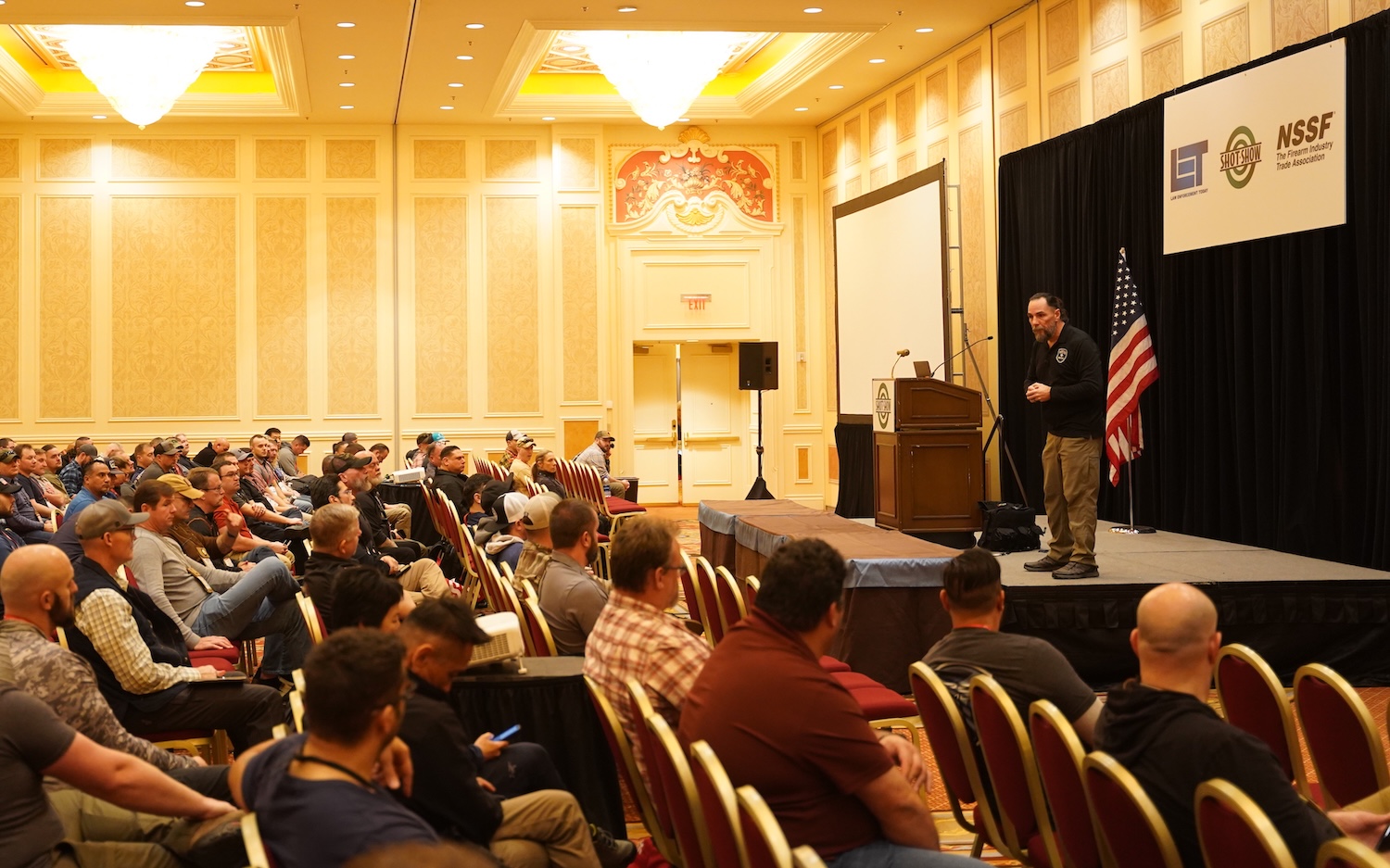
During the initial classroom session, Holschen discusses the responsibilities of armed citizens.
Classroom
John’s mission statement for his material specifically emphasizes increasing the survivability of himself and his students in the arena of lethal force encounters.
Some of the research involved came from Force Science and Professor Joan Vickers, as well as a number of performance and sports-centric studies.
We reviewed the White Settlement church shooting with the aid of the interior surveillance video and a timeline breakdown. It reinforced an earlier point about the importance of perceiving sooner in an encounter.
To outline efforts to mitigate and terminate the Threat you are facing as quickly as possible, Holschen uses the following:
Act – to negate the Threat as quickly as possible; Position – intentional movement to a position that allows you to see what you need to see and do what you need to do;
Prepare – through mental rehearsal, visualize potential hostile acts (verbal, physical, or with weapons), what they look like, and your response to these cues;
Perform – do “the thing” immediately upon perceiving the cue. Move, apply the appropriate type of force, scan, communicate, ensure safety/security, and administer first aid.

One student is working through a problem on a target array while processing the changing stimuli.
Range Work
On the range, we worked on a variety of exercises. Some were purely vision-focused (pun intended), others involved shooting. They started with a single threat indicator, then Go/No-Go work. That evolved into multiple threats involving both Go and No-Go stimuli.
One repeatedly asked question was: When did the dot go out? Did you see it disappear or not? If you didn’t, where was your visual attention? Broad and downrange? Or had you gotten sucked into your sights?
Another way to expand one’s vision involved looking at an El Prez-like bank of targets, keeping your visual attention on a particular spot of the center target while shifting the handgun laterally.
While most of the drills utilized a solid dot or dots, some had blinking lasers. Interestingly, the blinking laser stimulates the part of the brain that perceives movement. Continuing in this area, consideration was given to whether the Threat was blocking a No-Shoot or being blocked by one.
When dealing with multiple threats (suspects) in depth, John wanted us to move to stack them. He prefers only facing one gun, versus multiple guns.

Three targets, each with its own projector and reflective screen. Martha is monitoring a student’s run.
Survivability
John mentioned that working on your width of vision is more important than the specific drill you are working on.
How is that going to increase your survivability? Broadening your vision enables you to identify other emerging threats. Equally important, it will aid in identifying non-hostiles and no-shoots entering the environment, allowing you to minimize harm to them.
We progressed into muzzle aversion drills by riding the recoil up and over the No-Shoot/No-Cover.

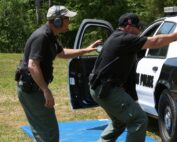
John is demonstrating how to work the corner & cover problem.
The live-fire portion of the class finished off with working around cover. There were two goals here – the first involved identifying the visual stimulus and shooting what the bad guy gave you, rather than exposing more of yourself than necessary for a center hit. And we did this while working with John’s method of working corners. I would not be able to do it justice within the limited space available.
Takeaways
In terms of takeaways, aside from continuing to work on broadening my vision, I need to emphasize initiating movement before the drawing.
After handing out the certificates, John offered the following to solidify the class’s material: over the next several days, carve out 5-10 minutes in a quiet place. Once there, re-visit the class material. Review the drills, running them in your mind’s eye. Work on expanding your view and visual attention. Not just one day, but several and frequently.

Students came from a diverse range of backgrounds. A/Is Martha Holschen and Marcin Porwit are definitely value-added with their perspectives.
Learning is defined as creating a persistent change in knowledge, skills, attitude, and ability. Re-visiting the material helps with that.
Broadening one’s vision will aid in increasing one’s survivability.
CONTACT
Heiho can be reached through West Coast Armory North