
 (+5 rating, 7 votes)
 Loading...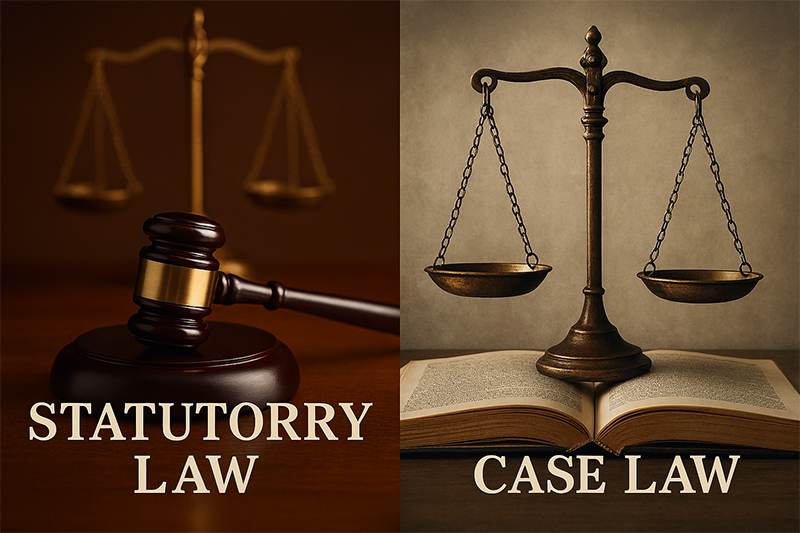
COP_Stat_Case_law
There are two kinds of laws that peace officers et al must be aware of when doing their jobs. The first is Statutory Law, and the second is Case Law.
Statutory Law?
“Statutory law is the term used to designate written law –or statutes– created by elected legislators and an official legislative process. It is the primary form of law used by the judicial system.
“Examples of statutory law include the minimum legal drinking age of 21 in the U.S. or the traffic violation of running a red light. These laws are not subject to interpretation by the court.” Source

Statutory laws are passed by legislative bodies and are the laws we enforce.
Case Law?
Case law refers to legal principles established by court decisions rather than written laws. It is a fundamental component of common law systems, where judges interpret past rulings (precedents) to resolve current cases. This approach ensures consistency and fairness in legal decisions. Unlike statutory law, which is written by legislative bodies, case law evolves through judicial interpretations. It plays a critical role in shaping legal frameworks and offers guidance for future cases, making it a dynamic and essential part of the legal system. Source
We enforce statutory laws, while case law addresses how those laws are interpreted.

Case law tells us how events and statutes are interpreted.
Clearly Established
For officers, case law decisions lead to the “clearly established” laws and rights that come into play in the aftermath of events and in any civil suits.
An example would be that after the United States Supreme Court’s 1966 ruling in Miranda v Arizona, 384 US 436 (1966), it is clearly established that an officer must advise someone of their Constitutional right to both remain silent and seek counsel prior to questioning – if they are in custody and being interrogated.
Subsequent rulings in other cases have clarified issues relating to “in-custody” and “questioning.”
Recently, the US Supreme Court (SCOTUS) issued a ruling in Scott v Smith. Reportedly, it targeted the issue of “clearly Established law.” And that alone strongly suggests that all officers need to be aware of the case and the Court’s ruling.
“Clearly established” is a significant issue when petitioning the Courts for Qualified Immunity (QI) and Summary Judgment (SJ) rulings during lawsuits.
Note: I am not a lawyer, and while I am staying in a Holiday Inn, I am not a legal expert. I am, however, a retired career cop who is familiar with the civil side of the Federal court system.

Officers and other governmental officials can seek qualified immunity if they are sued.
Qualified Immunity
This is a type of legal immunity that protects government officials from lawsuits alleging they violated an individual’s rights, allowing suits only when officials violated a “clearly established” statutory or constitutional right. “Qualified immunity balances two important interests—the need to hold public officials accountable when they exercise power irresponsibly and the need to shield officials from harassment, distraction, and liability when they perform their duties reasonably.” Source

A pre-trial ruling from the court based on inarguable facts.
Summary Judgment
A summary judgment is a judgment entered by a court for one party and against another party without a full trial.
“In civil cases, either party may make a pre-trial motion for summary judgment. For that motion to succeed, the moving party must show:
- There is no genuine issue of material fact, and
- The movant is entitled to judgment as a matter of law,
“A “genuine issue of material fact” exists if evidence could allow a factfinder to decide against the movant. A movant is entitled to judgment as a matter of law if evidence no reasonable jury could rule against the movant based on the facts.
A note on Q/I and S/J – it is reviewed with an eye towards the presented “facts” being looked at in a light most favorable to the non-moving party. That is generally the plaintiff, since the defendant is usually the one asking for Q/I and S/J. Unfortunately, for many years now, we have seen increasingly wild claims from the plaintiffs’ bar. So much so that it seems the bar for Q/I and S/J has shifted too far in the plaintiff’s direction.
Scott v Smith 23-15480 (9th Cir. 2024)
This was a hands-on use-of-force case, rather than an officer-involved shooting.
After resisting and struggling, the suspect was in a prone control position. His hands were behind his back, but he was not yet handcuffed. An officer’s body weight was on his shoulders. Once cuffed, the body weight was removed.
The suspect later experienced medical distress and eventually died.
On the initial appeal, the court cited Drummond v. City of Anaheim, 343 F.3d 1052, 1056 (9th Cir. 2003). However, in that case, the suspect had already been handcuffed, and he was not resisting. The body weight was on the neck and the shoulders. Despite warnings, the officers continued to apply pressure. Ultimately, the suspect went into a coma.
Compare the two fact patterns. Specifically similar or not?
When the case was appealed to SCOTUS, they reviewed it in light of Zorn v. Linton, 607 U.S. (2026).
The Court noted:
Officers are entitled to qualified immunity unless they have “read” the relevant precedent beforehand and “known” that it proscribed their specific conduct.
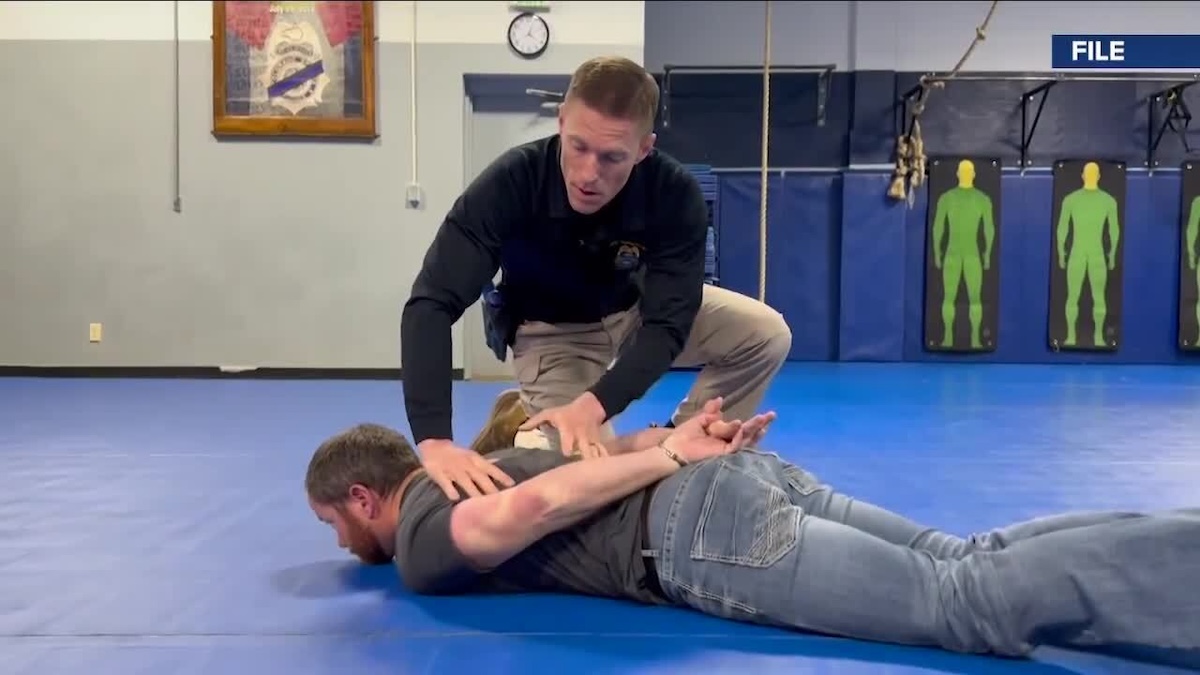
One example of a prone control position, with a handcuffed subject and weight on the shoulder.
The Court emphasized:
– Courts must identify a case involving similar facts and circumstances
– The rule must be defined with a high degree of specificity
– General principles (e.g., “no excessive force”) are insufficient
– The analysis must focus on whether precedent would have clearly informed an officer in advance.
SCOTUS sent the case back to the 9th Circuit with instructions to revisit its decision within the narrow scope set forth in Zorn.
Final Thoughts
What does that mean for you as an officer? Read case law, know it, and be able to apply it on demand. And then be more than willing to advocate for yourself should you be sued.
The legal definitions include the sources. The case summary was written by Steven Papenfuhs, a retired San Jose, CA, police sergeant, academy instructor, and current trainer. Through his business, Insight Training Strategies, he makes his case law summaries available to officers. Papenfuhs has graciously given me permission to share his work. He can be reached HERE
Any errors in this article are mine.