
 (+6 rating, 6 votes)
 Loading...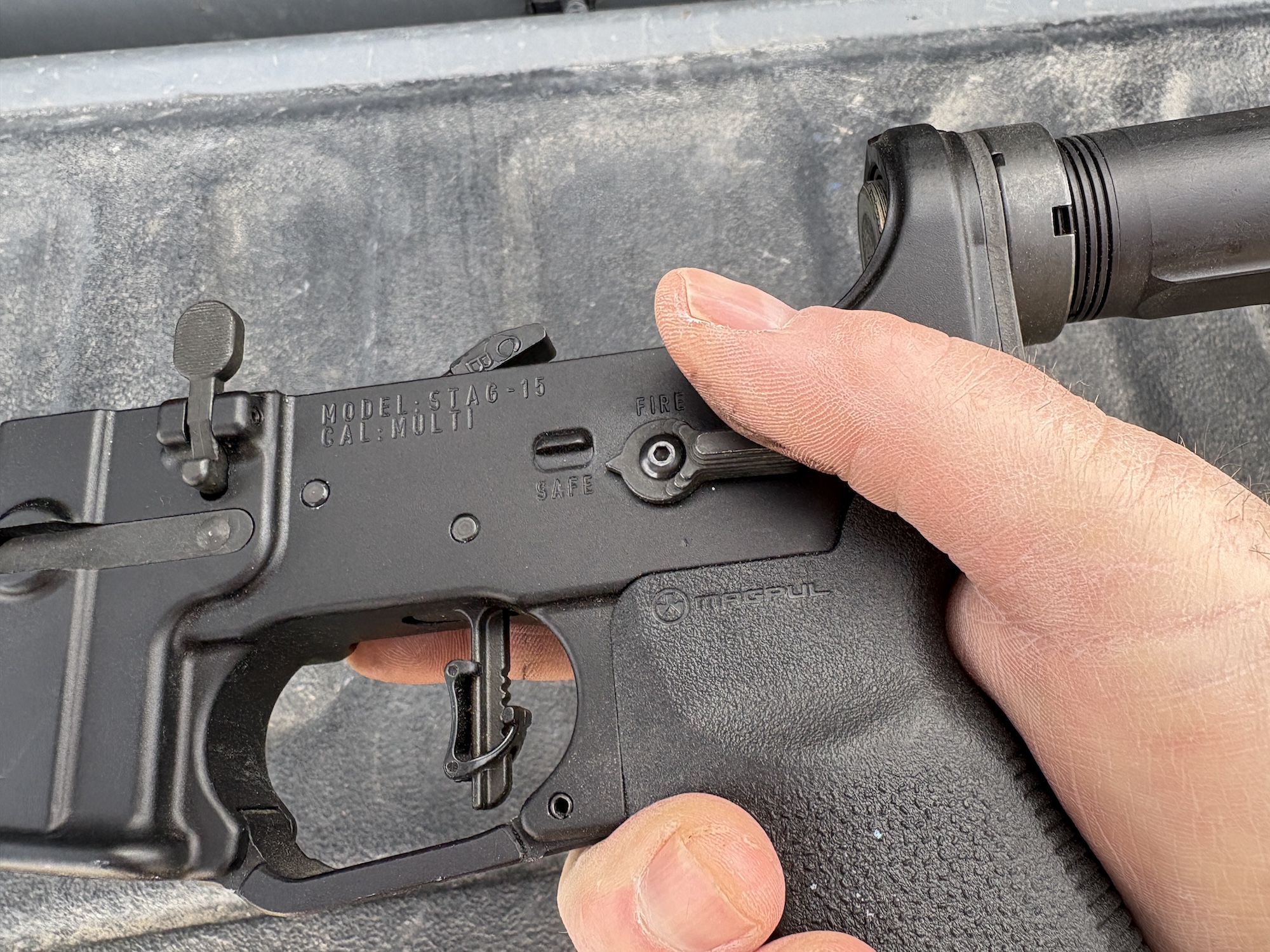
nij-feature
Regardless of manufacturer, current designs do not completely meet NIJ's goal for ambidextrous controls.
Are there measurable standards for law enforcement equipment? Yes. Unfortunately, beyond body armor, their existence is not well known. Some exist only in draft form and are released for comment.
One of those is the National Institute of Justice’s Patrol Rifles for Law Enforcement. It was published in December 2018 with this introduction:
“The final version of this document is anticipated to be published in late 2019 as a new NIJ Standard entitled Patrol Rifles for Law Enforcement. Its primary purpose will be for use by the NIJ Compliance Testing Program (CTP) for testing and evaluation of semiautomatic patrol rifles for certification by NIJ.” (p. 2)
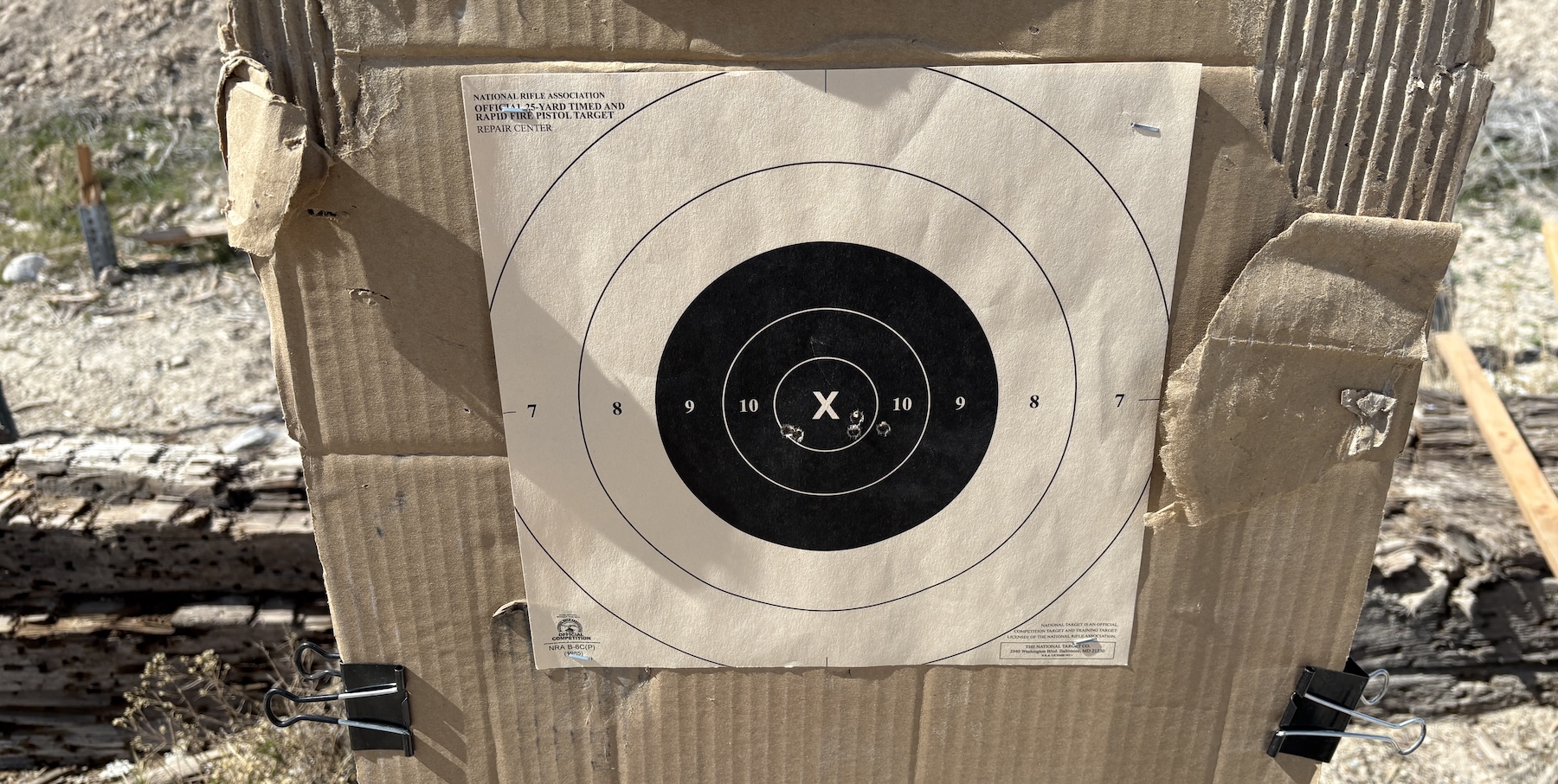
Confirmation group shot at 50 yards before going back to 100 yards.
Although it’s not currently on the NIJ website, you can find the document HERE.
Comments were accepted between December 2018 and March 2019. It does not appear to have moved beyond draft form since then. The comparable pistol standard has been in effect since 2021.
The long-standing Defense Department/War Department Technical Data Packages are provided only to certain firearms manufacturers under government contracts.
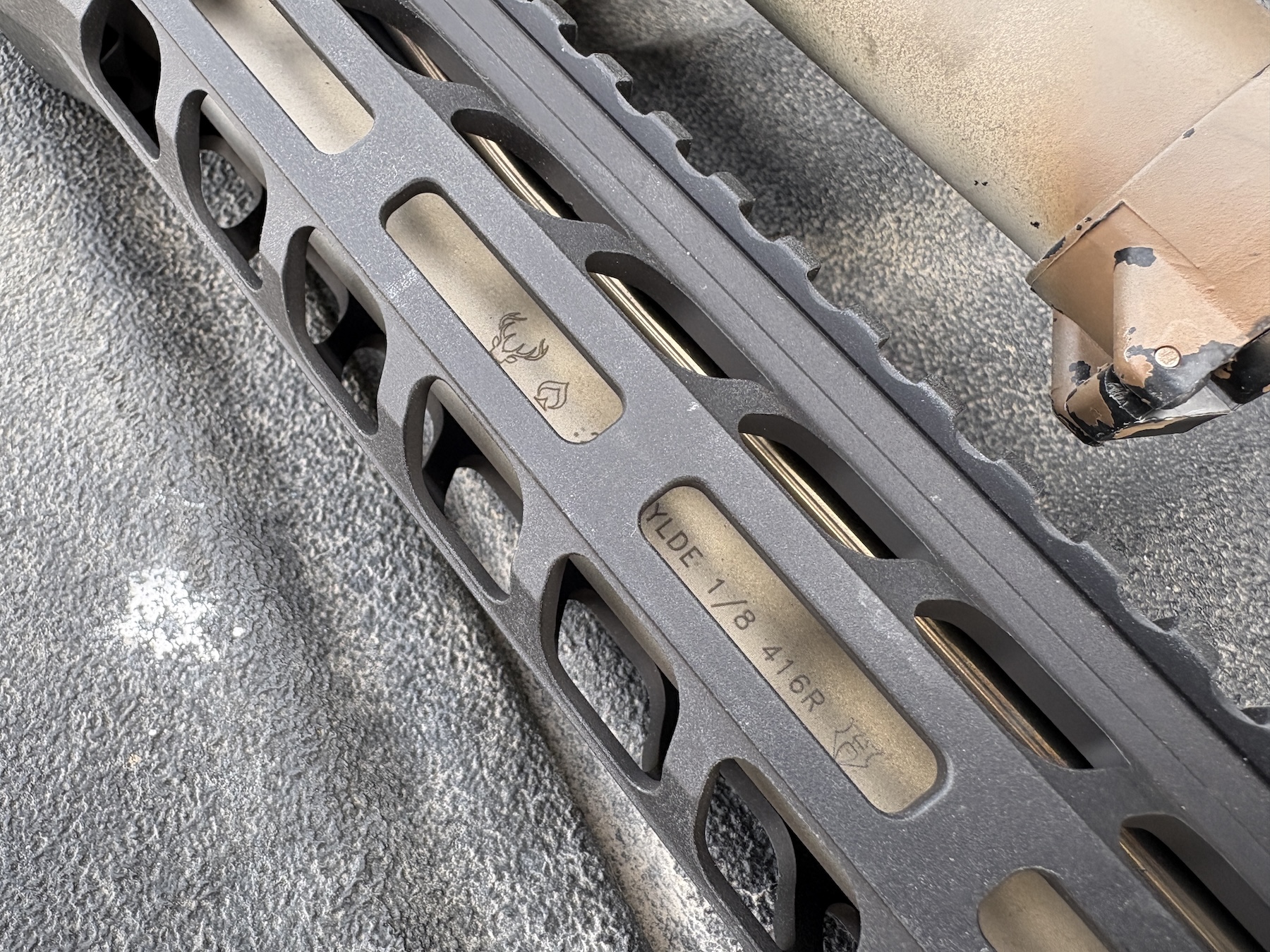
Stag Arms’ Stag-15 comes with a 1/8 twist stainless barrel chambered in .223Wylde. I shot 55-grain loads from High Desert, Hornady, and Remington-Peters during this range session.
This article looks at parts of the proposed standard using a Stag Arms Stag-15 3-Gun rifle they provided.
Scope
Section 1 discusses what the document does and does not address, including the establishment of a standard for new patrol rifles. It focuses on semi-auto rifles but allows select-fire models. Accessories such as optics and weapon-mounted lights are not covered.

One requirement is to shoot 60 rounds in under two minutes with no stoppages. There were no interruptions in the cycle of function.
Terms
The third section includes a lengthy glossary of firearm-specific vocabulary, helpful for those involved in the purchasing process who are not end users.
Features
On page 13, we get into standards. Some of the specific requirements are:
Function – “4.1 Patrol rifles shall be semiautomatic, or have semiautomatic firing mode, and magazine-fed.”
Ammunition – “4.2 Patrol rifles shall use current, commercially available ammunition produced for the law enforcement market.”
The calibers specifically listed are .223 Remington, 5.56x45mm NATO, .308 Winchester, and 7.62x51mm NATO. With a requirement that test samples must be in one of the calibers.
Agencies may choose other calibers “so long as the patrol rifle meets all the requirements of this document.” (p. 13)
All ammunition must meet the Sporting Arms and Ammunition Manufacturers’ Institute (SAAMI) or NATO’s standardization agreement standards.
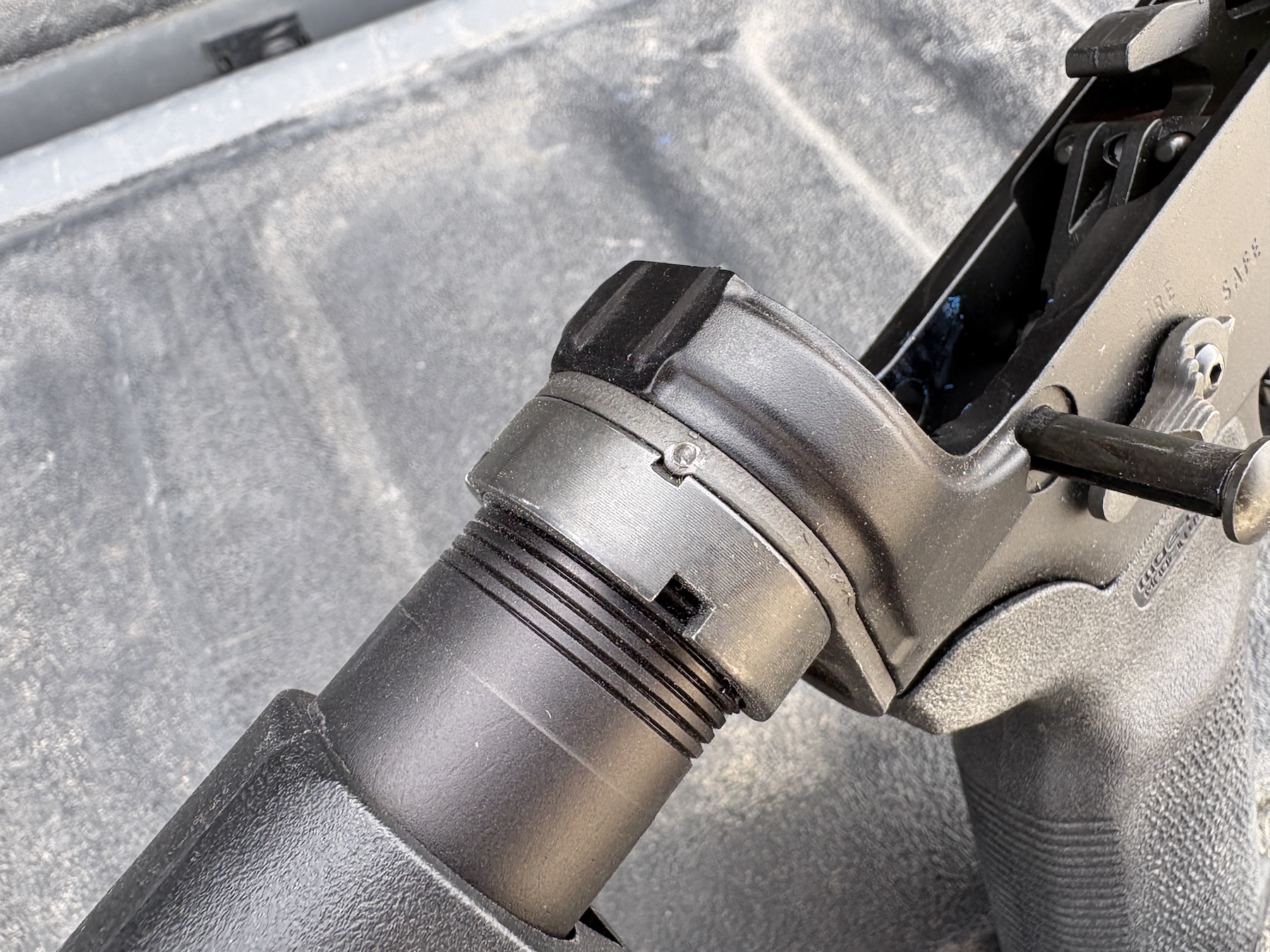
The Stag came with a properly stacked castle nut. Its carrier key was also done correctly. Good to see! The ambidextrous safety/selector and charging handle are necessary additions.
Regarding magazines, they must hold a minimum of twenty (20) rounds. There is more discussion about magazines later in the document.
Ergonomics
The rifle’s safety features should prevent “inadvertent firing” and be manipulated by hand.
Both left- and right-handed shooters should be able to easily operate the rifle without requiring any special tools or accessories.
Now, the interesting part from an ergonomics perspective, as well as being a left-hander.
“4.9 Safety, fire selector lever, and magazine release shall be manipulated using the firing hand only.
“NOTE: The fire selector lever may include the safety.
“4.10 The bolt catch/release should be manipulated using the firing hand only.
“4.11 The magazine release should be configurable for both right-handed and left-handed shooters or should be ambidextrous.”
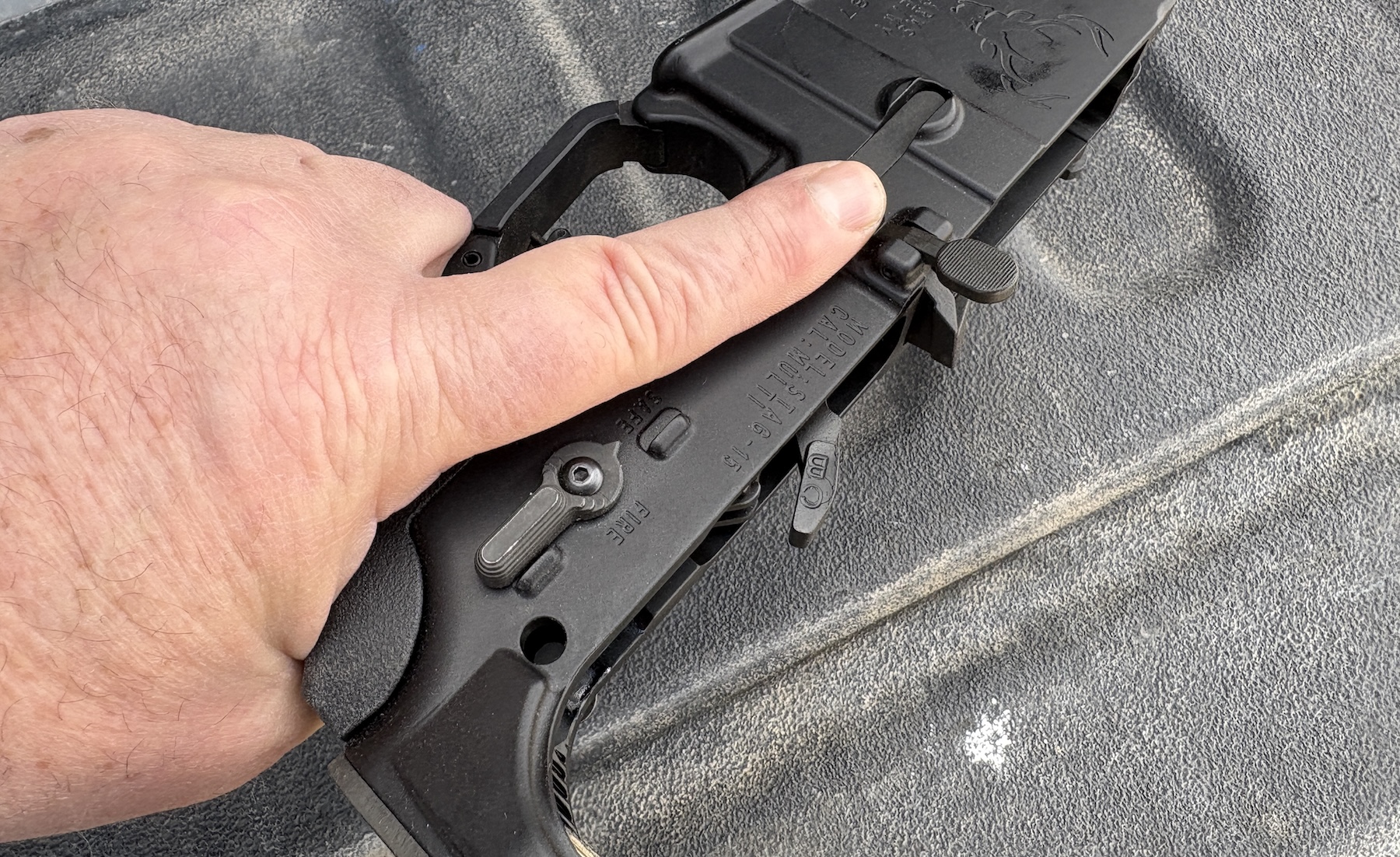
As a left-hander with most AR platforms, I can manipulate the safety/selector and the bolt catch, but not the magazine release, with my shooting hand. I work the magazine release with my weak hand thumb.
When shooting an AR-style carbine or rifle right-handed, I can work the safety/selector and the magazine release while maintaining a firing grip. However, I can’t use the standard bolt catch that way. When shooting left-handed, I can work the safety/selector and the bolt release with my shooting hand, but not the magazine release. I do press it with the thumb of my support hand.
More carbines and rifles with ambidextrous controls are coming to market. That is a good thing!
Some organizations have been aware of this need for a while. One example, the infantry battalion I went to Iraq with purchased and issued ambidextrous selectors for the left-handers.
Essential Functions and Malfunctions
Section 5 addresses five essential functions for the rifles. They include loading the magazine to capacity before inserting it into the rifle and removing it; the safety features must work and stay as set until the user manipulates them; the “patrol rifle shall feed and properly chamber each individual round/cartridge without inducing a stoppage”; the firing pin will strike the primer of each cartridge with enough power to fire it without causing a stoppage; and it will extract and eject both fired and unfired cases.
The Rounds Between Failure metric is one in 2000 rounds and covered in section 7.
Safeties must function with the shooter’s firing hand.
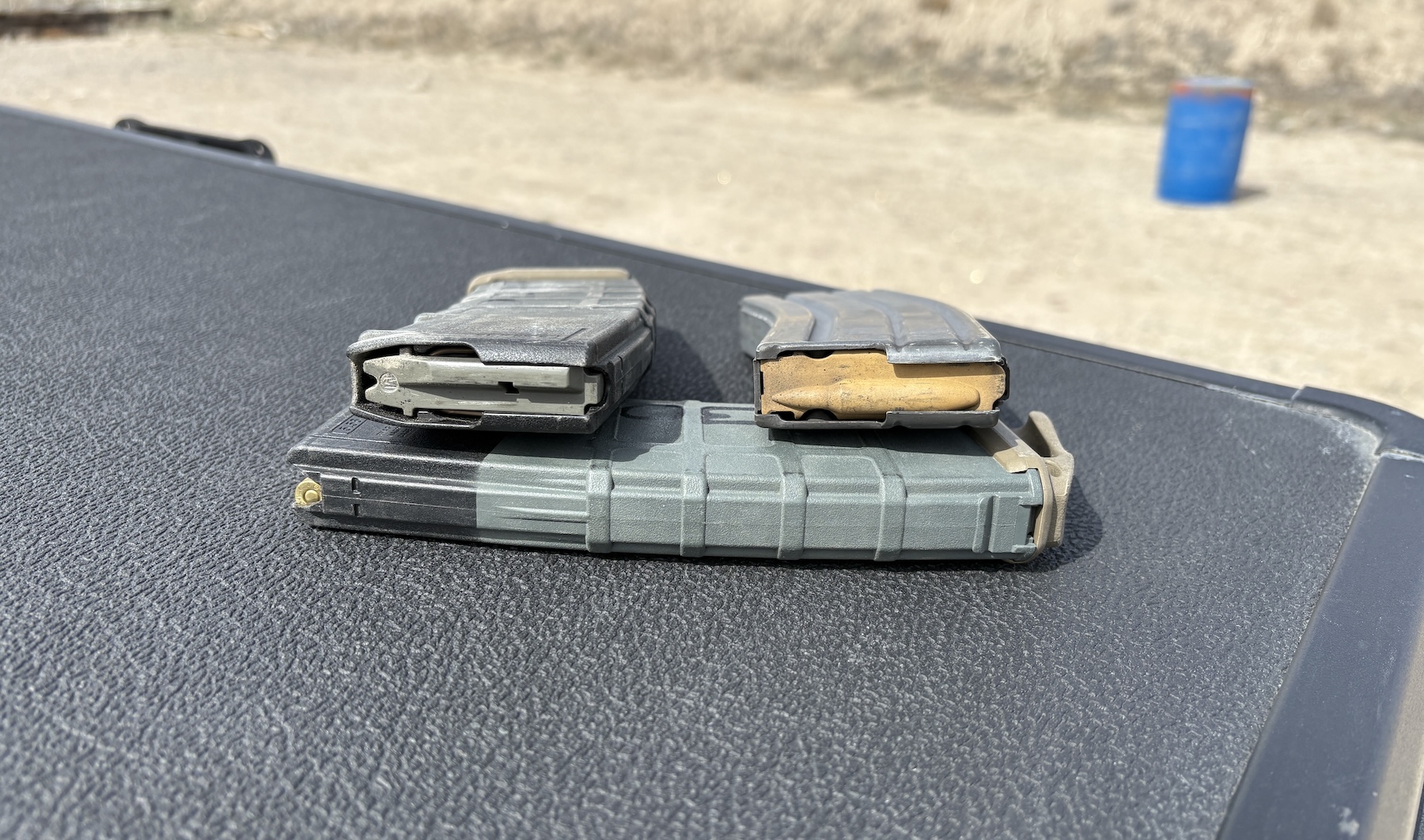
The magazines from MagPul and Okay Industries functioned as intended. That’s an interesting follower design on the right.
Functional Requirements
These include a visible finish, headspace meeting SAAMI or NATO/STANAG standards, and smooth operation rather than binding.
Regarding the magazines, they must hold their stated capacity, fit properly in the magazine well, drop free when the rifle is parallel to the ground, and function after being dropped.
In terms of operation, it must complete the eight-step cycle for sixty rounds without a stoppage.
The trigger weight shall be at least 3.5lbs and less than 10lbs. Using a mechanical trigger pull gauge, I found my rifle consistently broke at just over 3 1/2lbs. It can’t change more than 1.5lbs over its service life.
Precision and Accuracy
When shot at 100 yards, a five-shot group cannot exceed four inches. That group cannot be more than 4” from the point of aim.
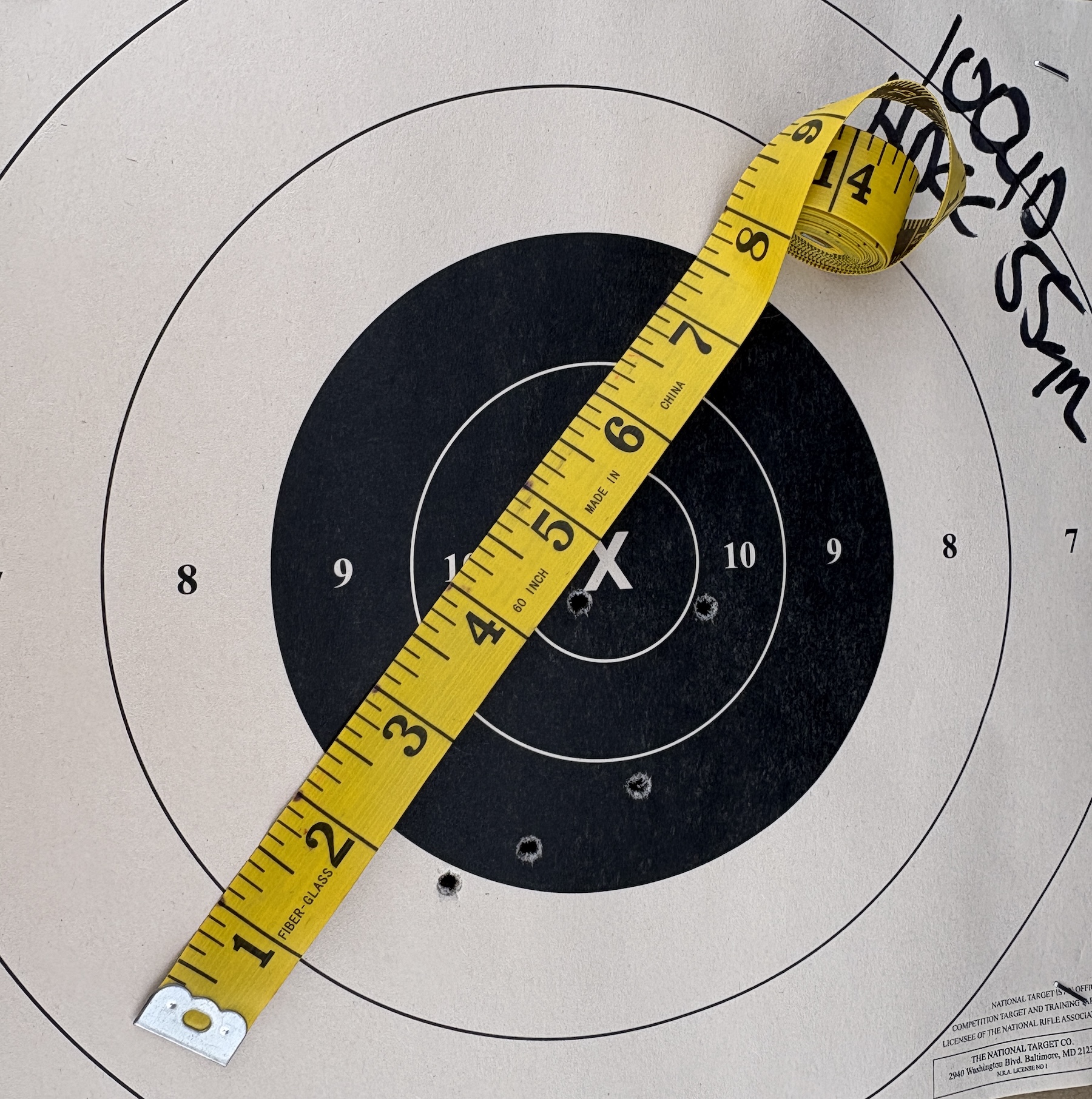
The NIJ document requires a sub-4″ group at 100 yards, within 4″ of the point of aim. High Desert Cartridge Co’s 55-grain ball positively contributed to this.
Performance
The manufacturer needs to submit three rifles for each test, but I only had one. As a result, I did not attempt some tests. In addition to endurance testing (10,000 rounds each) along with accuracy and precision, there are drop and various environment tests – high and low temperatures, salt water, and sand. Most agencies cannot conduct these; they must rely on test data from independent laboratories.
Ammunition
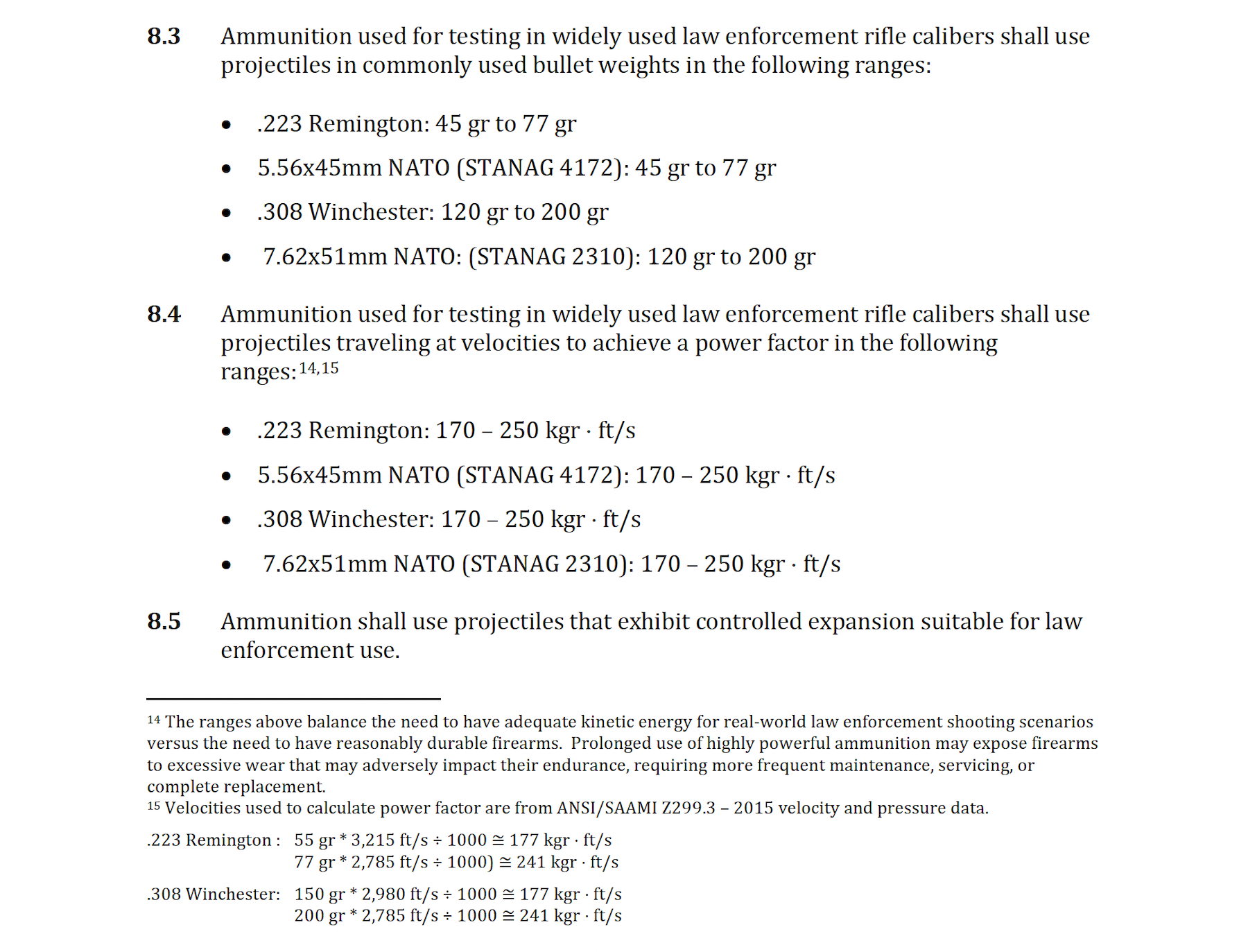
Here is the document’s discussion of acceptable ammunition.
Test Methods
This is a lengthy and exhaustive section, as it should be. It addresses visual examination, headspace, loading and unloading, cycle of operation, trigger, safeties, precision, accuracy/grouping, and the performance tests above.

Shooting the 100 yd 5-shot group. I used a 1-4x S&B Short Dot in a Larue mount.
Equipment
I used a Stag Arms 3-Gun rifle with a .223Wylde chamber, a Schmidt & Bender 1-4x Short Dot, and Lead Faucet’s sling. My magazines were from Magpul and MMMM. Ammunition was 55-grain ball from High Desert Cartridge Company, Remington-Peters, & Hornady.
Final Thoughts
NIJ must update and publish these standards. Agencies should consider using them when making equipment decisions.
RESOURCES