
 (+5 rating, 7 votes)
 Loading...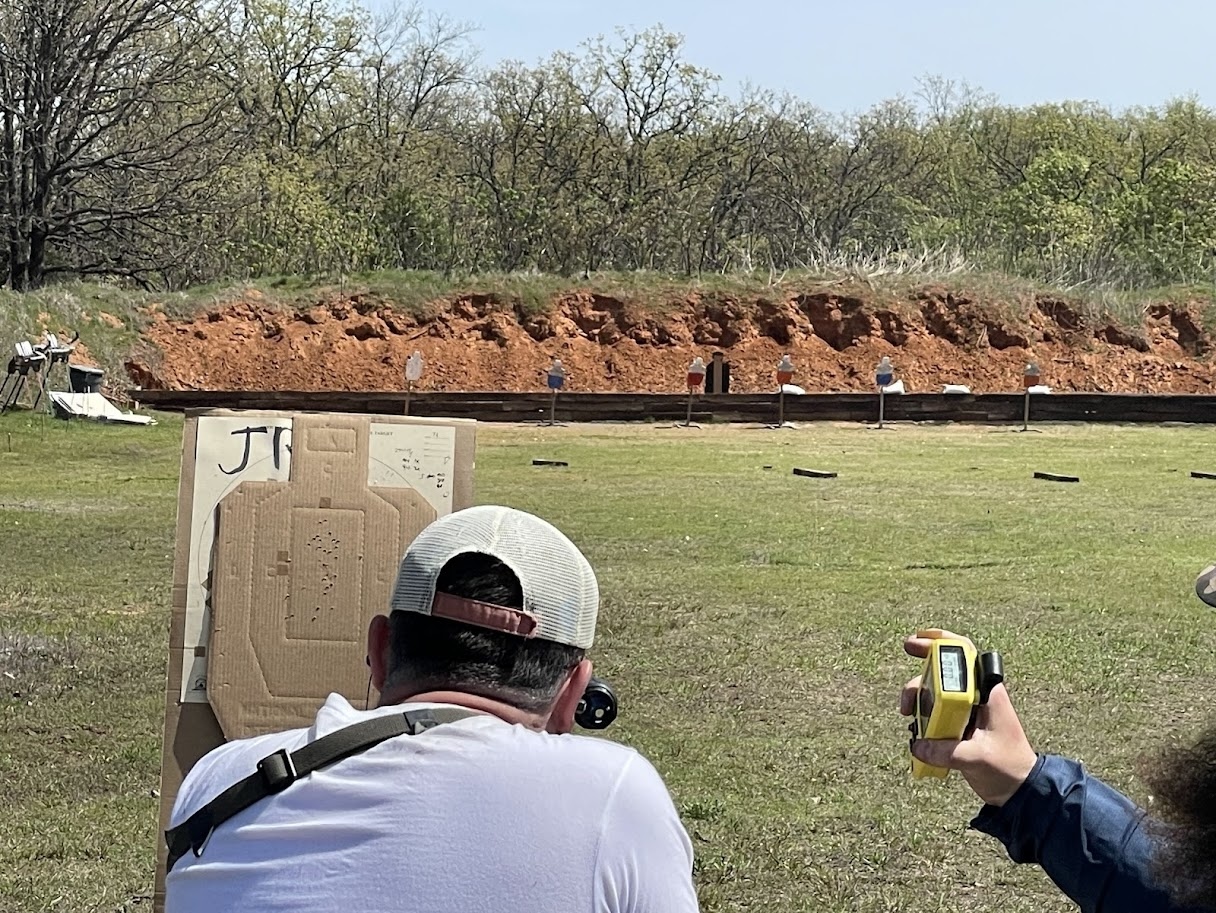
006 – near to far far to near
To work shot cadence, students alternate engaging paper at arm’s length and then steel targets at 100 yards or steel and then paper under time pressure.
Most of us have been through some patrol rifle course (or courses). Such classes run two or three days and cover a variety of topics from the fundamentals of rifle marksmanship to rifle maintenance.
There is nothing “wrong” with such classes, but what if there was more to fighting with the rifle than shooting Bill Drills at 10 yards? What if there was someone who could identify the critical but neglected subjects needed to be fully capable with the rifle? What if this person had decades of experience using the rifle in the worst places, under the harshest conditions? Such a class exists, and it is “No Fail Rifle” from Presscheck Consulting.
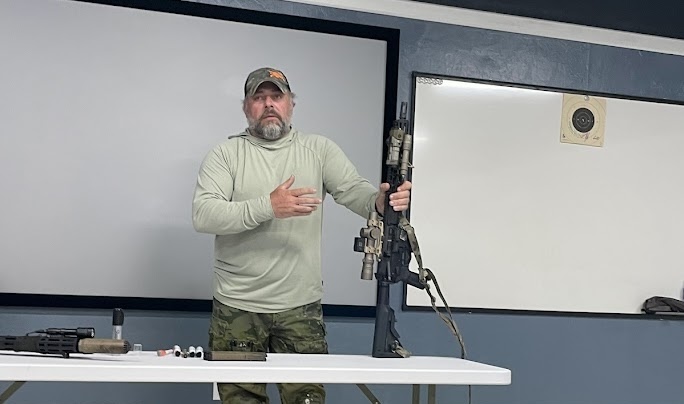
Starting in the classroom, the non-stop stream of information and hard-won lessons is shared by Pressburg.
The Instructor
The lead instructor is Chuck Pressburg, who is uniquely qualified to develop and teach this material. Pressburg is a 26-year military veteran, having spent almost all that time in Special Operations or Special Mission Units. He was a member of our military’s foremost hostage rescue unit. He weaves his extensive combat experience into the class to highlight critical lessons.
This offering of No Fail Rifle was held at Oklahoma’s Meadhall Range. Meadhall is an amazing, privately owned training facility with an impressive infrastructure, including a top-tier classroom, shooting simulator, turning targets, moving targets, on a 300-yard range with a shooting tower.
No Fail Rifle has a simple goal – to provide students who have a basic understanding of their carbine with the important material that isn’t included in the typical class. If a basic carbine class is rifle knowledge, volume one, No Fail Rifle is the next two volumes.
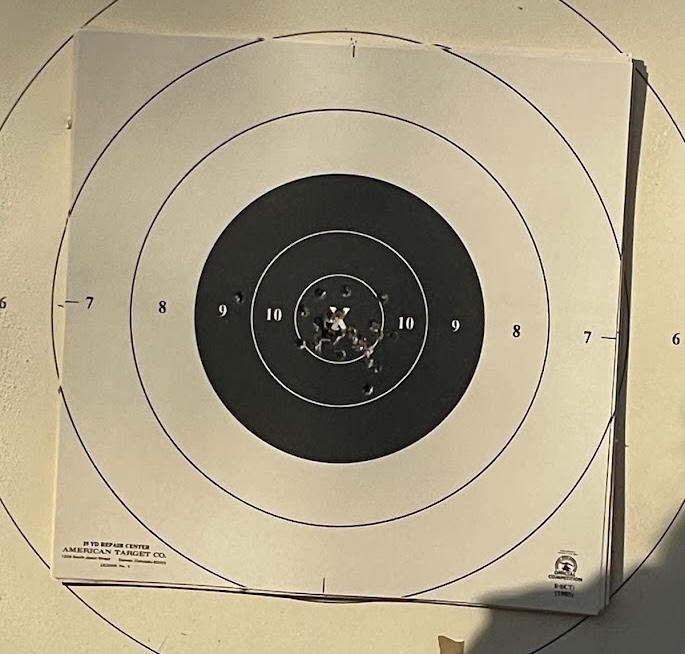
When close, students shoot for X’s. The author’s 299 with 26 X’s wasn’t good enough to win this challenge.
Classroom
Starting in the classroom. Pressburg explains how pistols and carbines are different. To summarize, pistols are harder to shoot and don’t work as well, but they hit where you aim them. Rifles are like shooting in “easy mode” and are dramatically more effective, but the bullet rarely intersects with the dot or reticle – it spends most of its time above or below that line. The challenge with the rifle is to know where the bullet will be in relation to the aiming point and its actual flight as influenced by distance, environmental conditions, cant of the rifle, etc.
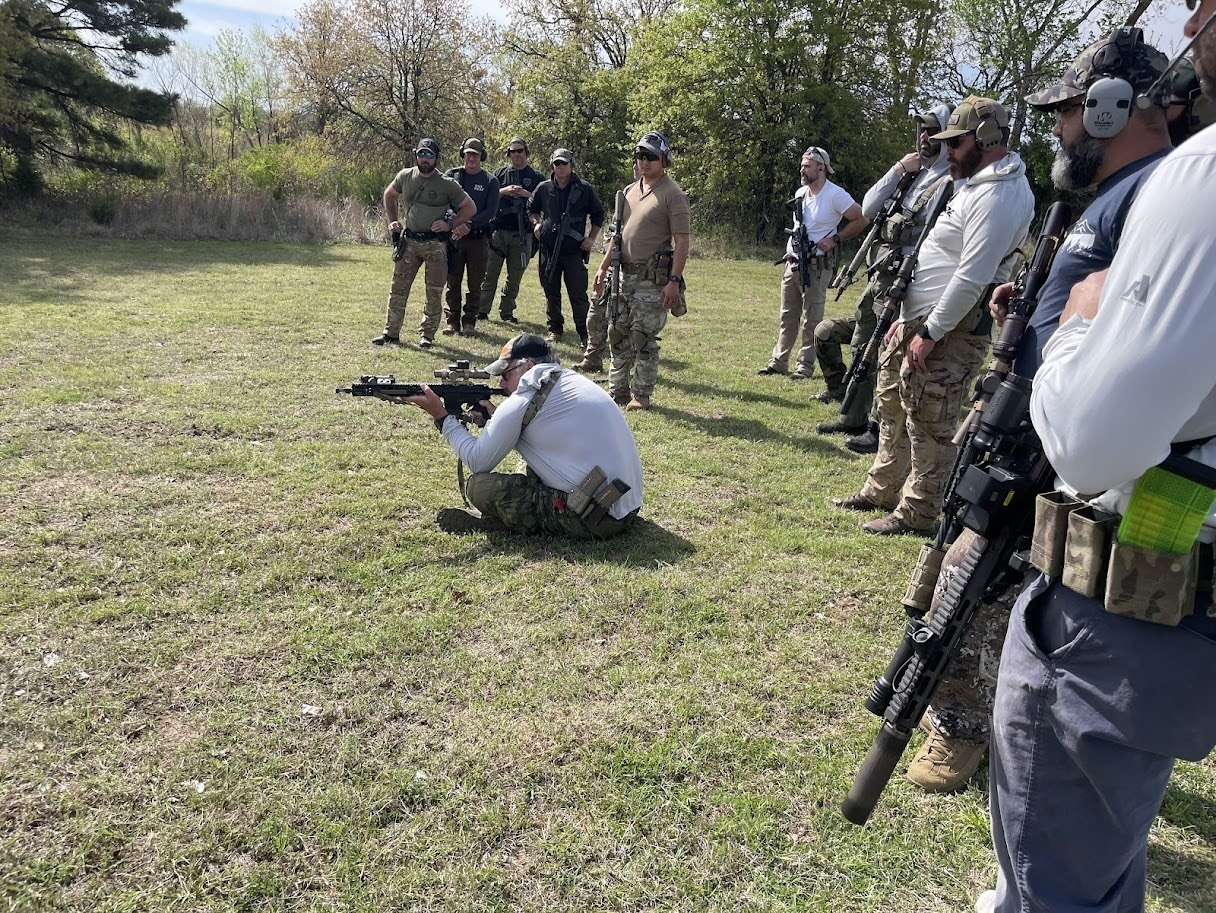
Pressburg covers techniques that he found useful in the real world, often neglected, like alternative shooting positions.
Suppose you are in a rollover prone under a car, 100 yards away, and are presented with just the threat’s head for a few seconds. This is a complex shot because of the target size, distance, and the rifle being on its side. Because the carbine is easier to shoot, if you know where the bullet is going, it is very easy to hit, but you must know what your bullet is going to do. Ultimately, the shooter must deliver the round regardless of how “hard” the shot is. That means they must understand their rifle, their ammunition, and their zero.
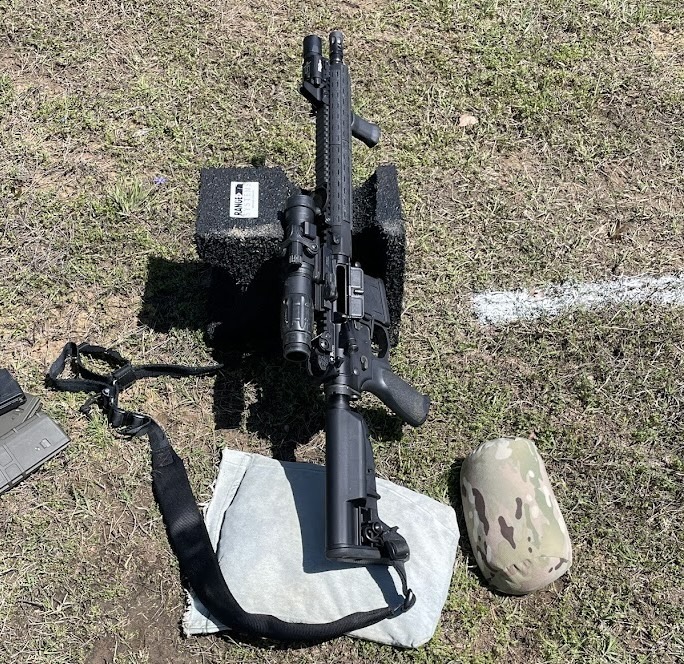
To minimize shooter error and get the best information, rifles are thoroughly braced at the front and rear.
Data
To accomplish this goal, the student needs information and ballistic data. Pressburg provides a lot of that information in the classroom. One of his gifts is the ability to distill complex concepts so they are easily understood and still useful. Chuck systematically explains the three kinds of ballistics, the advantages and disadvantages of various zero distances, the effect of equipment choices (especially optic mount height), etc. Once our heads are thoroughly filled with the theory of what we’re going to do, we move to the range to do it.
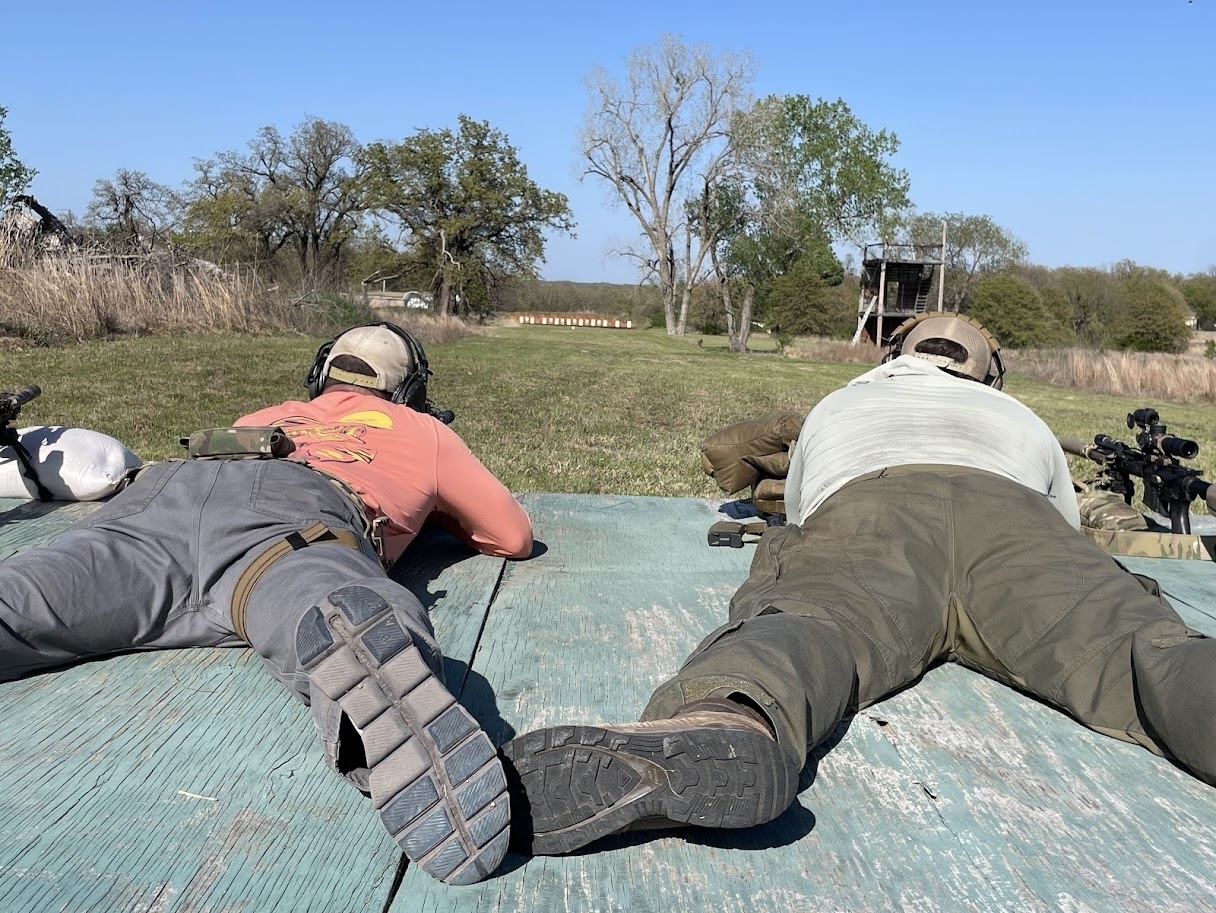
Data collection is pushed back to 300 yards thanks to Meadhall’s excellent facilities.
First Shots
On the range, we start the process of gathering the ballistic data we’ll need to solve shooting problems presented later in the class. Pressburg believes that errors from the shooter should be as minimal as possible in this process. To that end, we are encouraged to stabilize the gun as much as possible, with most students using a rest or bipod for the front of the gun and a bag for the rear. This also allows the student to understand what their equipment is capable of and how performance decreases once these aids are removed.
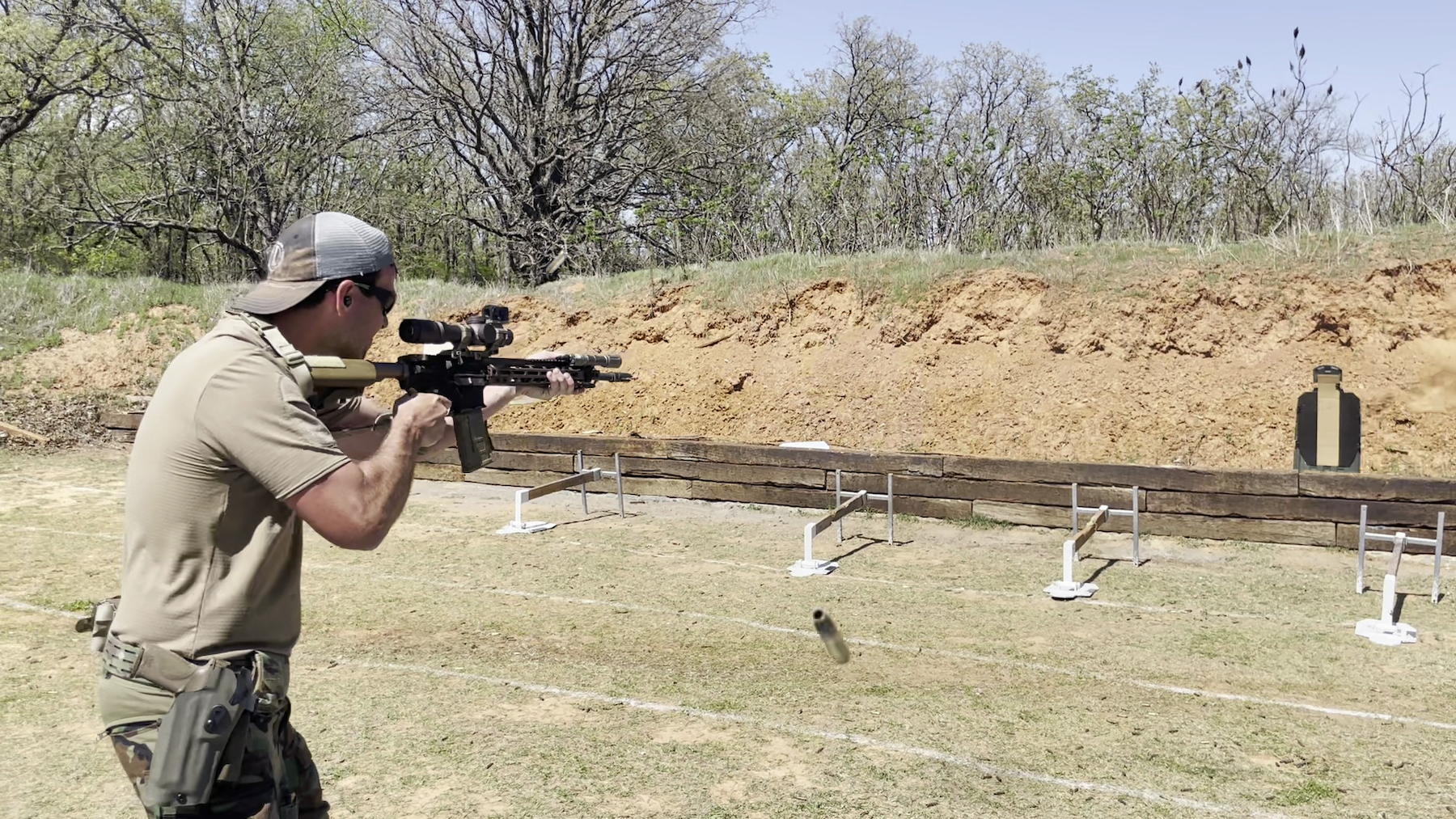
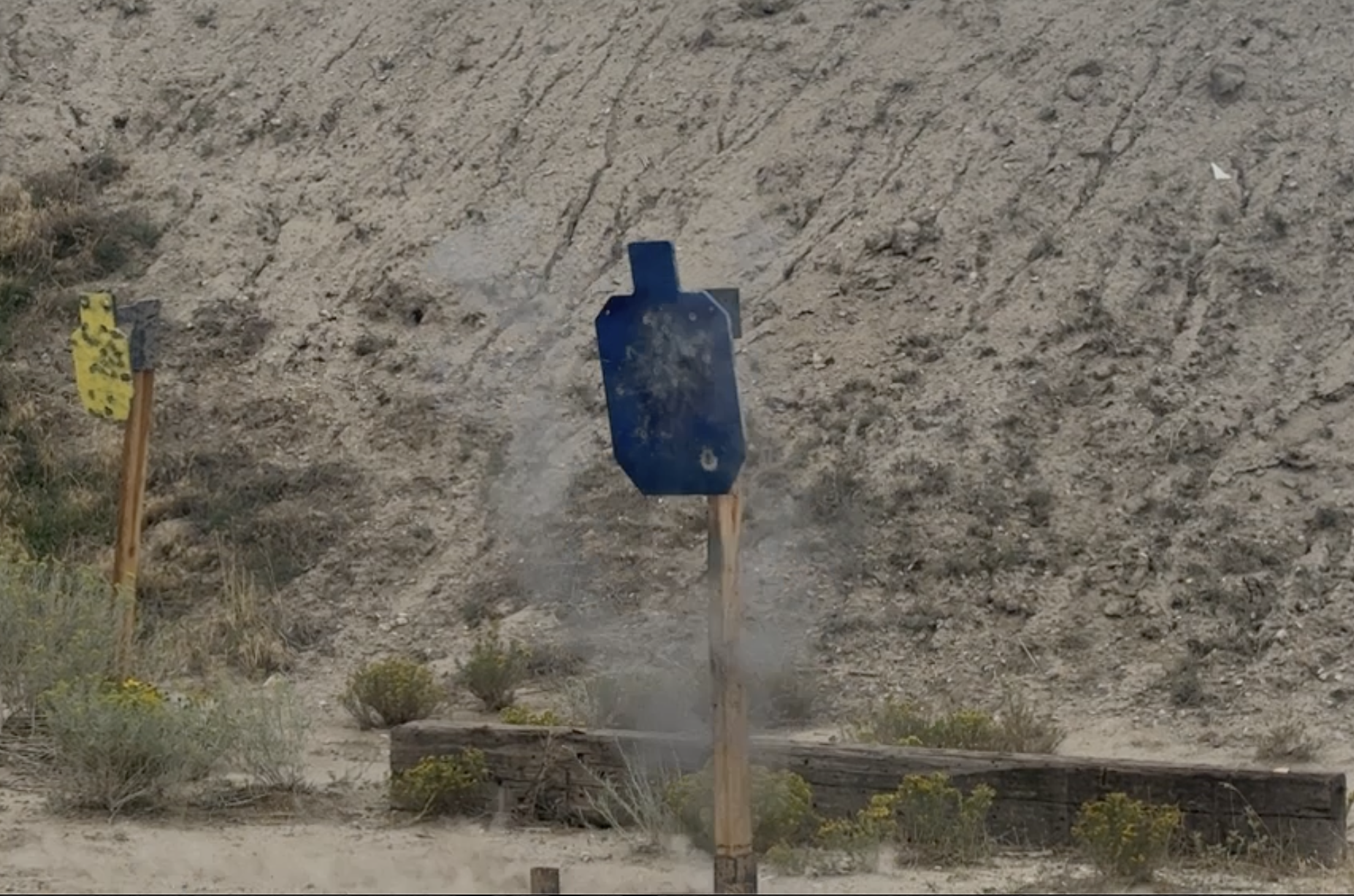
Brass flies as Meadhall’s mover provides the rare chance to engage rapidly moving targets.
From here, we start to shoot. First, fine-tuning zeroes and then opening the distance to understand what our guns are doing. Because we need detailed information, we use a detailed target – the B-8 bullseye. The target is big enough to catch any errant rounds but provides a small enough aiming point to really understand what’s going on as the variables change. We shoot at 100, 200, and 300 yards.
To round out the day, we continue gathering data at CQB distances. This isn’t any hit on a silhouette shooting; rather, our accuracy goal is the X ring of the B-8 from 3 yards to 25 yards. To keep the pressure on, we shot scored courses that are settled by X counts.
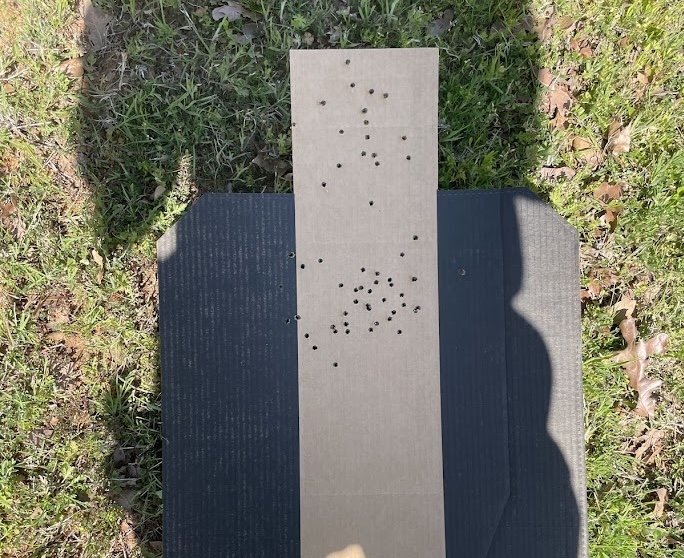
The author’s work on the mover. The narrow target is used to simulate a threat turned sideways.
The Second Day
Day two is spent introducing new material that amounts to the fine details of shooting the rifle to the ragged edge of its capabilities. Recoil control, alternative positions, throttle control, shooting with the gun at odd angles, shot placement, moving targets, and shooting while moving are all covered with attention to the nuance of small details that show a deep understanding of each topic. The day ends with a culminating exercise that brings many of these skills together in an elimination contest that pits the whole class against one another while testing mental fortitude, the ability to hit on demand, and physical prowess.
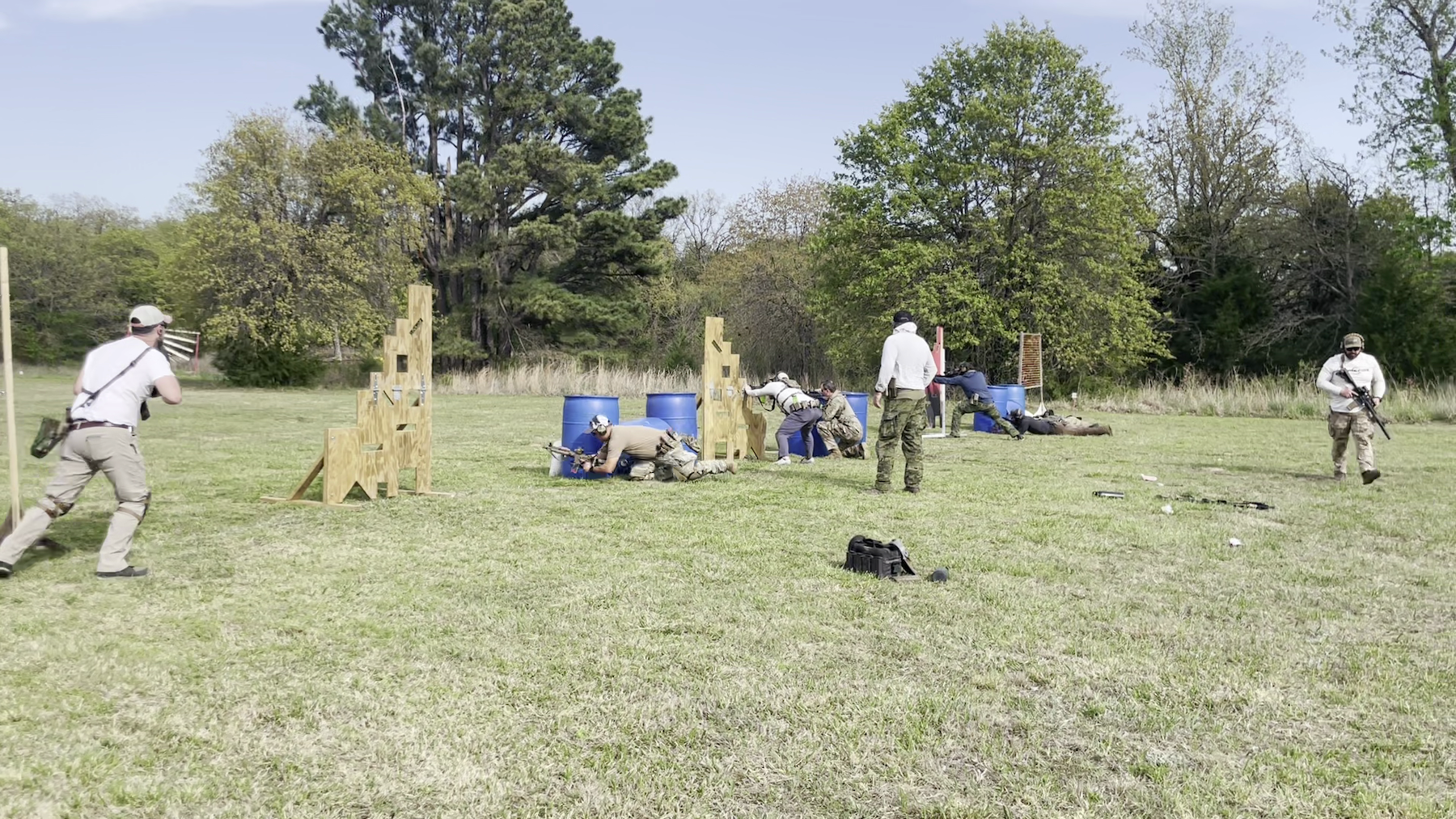
The final drill pits the entire class against one another in a cutthroat elimination drill. It demands marksmanship, the ability to move in and out of positions quickly, and a good base of aerobic capacity.
Final Thoughts
It is difficult to explain how thoroughly Pressburg expands the students’ knowledge of the rifle. I’ve taken over 400 hours of carbine training from both private sector and governmental shooting programs. Pressburg continuously impressed me with his depth of knowledge and the ability to convey it during two days of training. If you can already run and hit with your rifle, this course is absolutely worth your time. It will take your knowledge and ability to the next level.